 Add to Chrome
 Add to Firefox
 Add to Edge
A Heterogeneous Architecture for Robot RL Beyond GPU-Dominant Paradigms
May 28, 2026
Simulation-based RL for contemporary robot control is increasingly organized around GPU-resident simulation: physics, rollout collection, and learning are placed on a single GPU-centric execution path. This paradigm has greatly improved training speed, but it has also encouraged a default assumption that efficient training requires physics to reside on the GPU. We revisit this assumption. Our view is that, in simulation-dominated robot control, the essential question is not which processor runs physics, but whether simulation throughput, policy learning, and runtime synchronization form an efficient end-to-end loop. We present UniLab, a heterogeneous CPU-simulation / GPU-learning architecture that decouples CPU-parallel simulation from GPU policy updates through a unified runtime for data movement, buffering, and synchronization. UniLab is implemented as a complete and extensible training system using MuJoCoUni and MotrixSim CPU-batched physics backends, supporting PPO, SAC, FlashSAC, TD3, and APPO. On representative simulation-based robot control tasks, UniLab improves end-to-end training efficiency by 3--10$\times$ under the same hardware configuration, while reducing dependence on the NVIDIA CUDA-based software stack and supporting cross-platform execution on the Apple macOS platform and the AMD ROCm and Intel XPU accelerator backends. These results show that GPU simulation is an effective path to efficient training, but not a necessary one, broadening the practical system choices available for robot RL training. Project page: https://github.com/unilabsim/UniLab.

MuJoCoUni:Persistent Batched Runtime Primitives for MuJoCo
May 24, 2026We present MuJoCoUni, a downstream MuJoCo distribution for online robot learning and batched physics evaluation. Alongside the open-loop batched trajectory generation already provided by upstream mujoco.rollout, MuJoCoUni supplies runtime primitives for stateful environment execution. The target workloads need high-throughput parallel execution while retaining upstream CPU MuJoCo semantics for models, sensors, contact, and constraints. Its core object, BatchEnvPool, is a C++/pybind11 executor that owns per-environment mjModel copies, per-thread mjData workers, and an internal thread pool. It provides final-state-only short stepping, sparse reset, reset-lifecycle domain randomization, batched sensor forward evaluation without advancing dynamics, and batched Jacobian and height-field queries. The implementation is confined to the Python binding layer; MuJoCo's solver, contact model, integrator, and core source tree retain upstream semantics. This report describes the BatchEnvPool API, implementation boundary, relationship to rollout, and the validation and benchmark scripts shipped with the open-source mujoco-uni package, which is installed with \texttt{pip install mujoco-uni}.
GS-Playground: A High-Throughput Photorealistic Simulator for Vision-Informed Robot Learning
Apr 28, 2026Embodied AI research is undergoing a shift toward vision-centric perceptual paradigms. While massively parallel simulators have catalyzed breakthroughs in proprioception-based locomotion, their potential remains largely untapped for vision-informed tasks due to the prohibitive computational overhead of large-scale photorealistic rendering. Furthermore, the creation of simulation-ready 3D assets heavily relies on labor-intensive manual modeling, while the significant sim-to-real physical gap hinders the transfer of contact-rich manipulation policies. To address these bottlenecks, we propose GS-Playground, a multi-modal simulation framework designed to accelerate end-to-end perceptual learning. We develop a novel high-performance parallel physics engine, specifically designed to integrate with a batch 3D Gaussian Splatting (3DGS) rendering pipeline to ensure high-fidelity synchronization. Our system achieves a breakthrough throughput of 10^4 FPS at 640x480 resolution, significantly lowering the barrier for large-scale visual RL. Additionally, we introduce an automated Real2Sim workflow that reconstructs photorealistic, physically consistent, and memory-efficient environments, streamlining the generation of complex simulation-ready scenes. Extensive experiments on locomotion, navigation, and manipulation demonstrate that GS-Playground effectively bridges the perceptual and physical gaps across diverse embodied tasks. Project homepage: https://gsplayground.github.io.
Imaginative World Modeling with Scene Graphs for Embodied Agent Navigation
Aug 09, 2025Semantic navigation requires an agent to navigate toward a specified target in an unseen environment. Employing an imaginative navigation strategy that predicts future scenes before taking action, can empower the agent to find target faster. Inspired by this idea, we propose SGImagineNav, a novel imaginative navigation framework that leverages symbolic world modeling to proactively build a global environmental representation. SGImagineNav maintains an evolving hierarchical scene graphs and uses large language models to predict and explore unseen parts of the environment. While existing methods solely relying on past observations, this imaginative scene graph provides richer semantic context, enabling the agent to proactively estimate target locations. Building upon this, SGImagineNav adopts an adaptive navigation strategy that exploits semantic shortcuts when promising and explores unknown areas otherwise to gather additional context. This strategy continuously expands the known environment and accumulates valuable semantic contexts, ultimately guiding the agent toward the target. SGImagineNav is evaluated in both real-world scenarios and simulation benchmarks. SGImagineNav consistently outperforms previous methods, improving success rate to 65.4 and 66.8 on HM3D and HSSD, and demonstrating cross-floor and cross-room navigation in real-world environments, underscoring its effectiveness and generalizability.
DISCOVERSE: Efficient Robot Simulation in Complex High-Fidelity Environments
Jul 29, 2025We present the first unified, modular, open-source 3DGS-based simulation framework for Real2Sim2Real robot learning. It features a holistic Real2Sim pipeline that synthesizes hyper-realistic geometry and appearance of complex real-world scenarios, paving the way for analyzing and bridging the Sim2Real gap. Powered by Gaussian Splatting and MuJoCo, Discoverse enables massively parallel simulation of multiple sensor modalities and accurate physics, with inclusive supports for existing 3D assets, robot models, and ROS plugins, empowering large-scale robot learning and complex robotic benchmarks. Through extensive experiments on imitation learning, Discoverse demonstrates state-of-the-art zero-shot Sim2Real transfer performance compared to existing simulators. For code and demos: https://air-discoverse.github.io/.
RKHS-BA: A Semantic Correspondence-Free Multi-View Registration Framework with Global Tracking
Mar 02, 2024
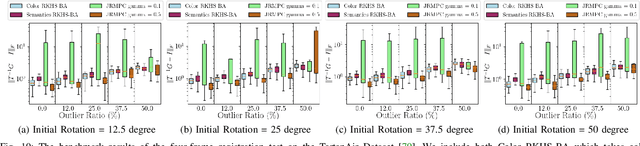
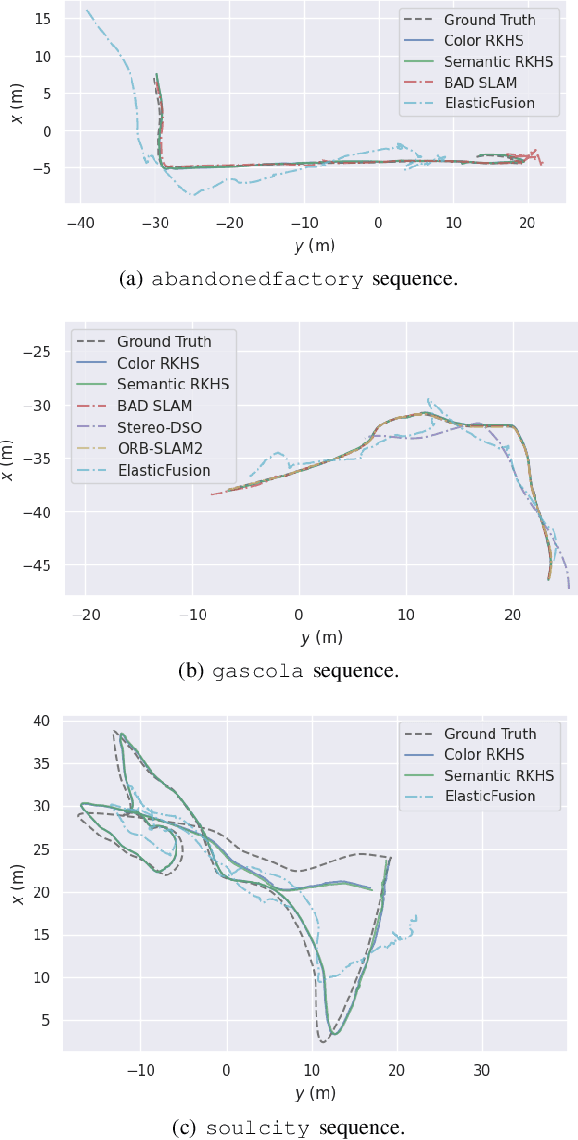

This work reports a novel Bundle Adjustment (BA) formulation using a Reproducing Kernel Hilbert Space (RKHS) representation called RKHS-BA. The proposed formulation is correspondence-free, enables the BA to use RGB-D/LiDAR and semantic labels in the optimization directly, and provides a generalization for the photometric loss function commonly used in direct methods. RKHS-BA can incorporate appearance and semantic labels within a continuous spatial-semantic functional representation that does not require optimization via image pyramids. We demonstrate its applications in sliding-window odometry and global LiDAR mapping, which show highly robust performance in extremely challenging scenes and the best trade-off of generalization and accuracy.